Most businesses do not have a traffic problem. Their ads get seen. They get clicks. Sometimes they even get messages.
The real problem starts after the click — when the people who enquire are not ready to buy, do not fit the offer, or never reply again.
This guide explains, in simple words, how Meta Ads (Facebook and Instagram ads) turn clicks into qualified enquiries — and how to check where your own funnel is leaking.
First, Four Words You Must Understand
People mix these up, and that is where most confusion begins.
- Reach means people saw your ad. Nothing more.
- Clicks mean people were interested enough to tap. Still not a lead.
- Leads mean someone shared their details or sent a message. Better — but a lead is only a name and a number.
- Qualified enquiries mean the person actually fits your offer, understands it, and is worth your sales team’s time.
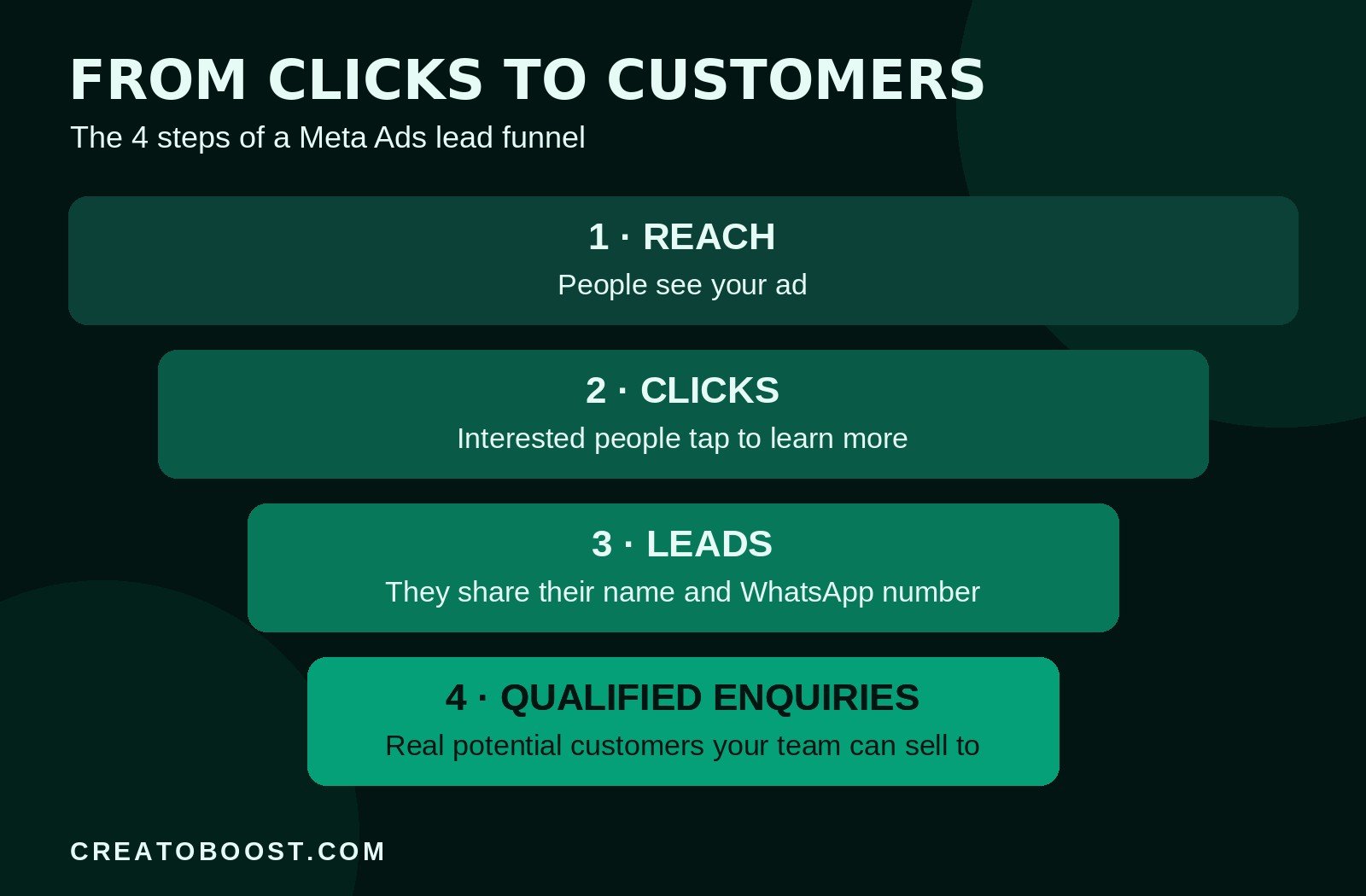
A campaign can look “successful” on reach and clicks and still bring zero business. Judge your ads by the last step, not the first one.
The 5 Parts of a Lead Generation Funnel
Every good Meta Ads lead campaign has the same five parts. If results are weak, one of these five is usually broken.
1. The Audience
Meta needs to show your ad to people who could realistically buy. Start with the basics: location, age range, and the interests or behaviours closest to your real customers.
Then improve it over time. Your best audiences usually come from your own data — website visitors, Instagram engagers, and lookalike audiences built from real customers, not guesses.
2. The Creative
The ad itself — the video or image, and the first line of text — does most of the work. In our experience, changing the creative changes results faster than changing the audience.
For lead generation, the creative must do three jobs:
- Stop the scroll with a clear problem or promise
- Explain the offer in plain words
- Tell the viewer exactly what to do next
Short video ads work especially well here, because a person can explain an offer in 20 seconds in a way a static image cannot. That is why so many lead campaigns now start with AI video ads or a presenter-style video.
3. The Offer
People do not enquire because they saw an ad. They enquire because the offer made the next step feel easy and safe.
Weak offer: “Contact us for details.”
Strong offer: “Get a free audit of your current ads. We will show you exactly where your budget is leaking — no commitment.”
The clearer and lower-risk the first step, the more enquiries you get — and the better they usually are.
4. The Landing Page or Lead Form
Where the click lands matters as much as the ad. Two rules:
- Say the same thing. If the ad promises a free audit, the page must open with that same free audit — not a generic homepage.
- Ask only what you need. Every extra field costs you leads. Name, WhatsApp number, and one or two qualifying questions are enough for most businesses.
This is also where honest qualification happens. One smart question — budget range, city, type of project — filters out people who were never going to buy, before they reach your sales team.
5. The Follow-Up
A lead that waits two hours for a reply is often a lost lead. The enquiry is hottest in the first few minutes.
Fast, consistent follow-up — a WhatsApp reply, a short call, a clear next step — is part of the funnel, not an afterthought. If your ads “don’t work” but your follow-up is slow, fix the follow-up first. It is the cheapest fix you will ever make.
Want us to check your funnel for you? CreatoBoost offers a free Growth Opportunity Audit — we review your ads, your offer and your follow-up, and show you where enquiries are leaking. Request your free audit
How to Judge Lead Quality (Not Just Lead Count)
Cheap leads are easy to buy. Useful leads are the point.
Once a week, sit with your sales team and mark every lead:
- Qualified — fits the offer, real conversation happened
- Unqualified — wrong fit, wrong budget, wrong location
- No response — never replied after enquiring
- Converted — became a customer
Patterns will appear fast. If most leads are unqualified, your ad is promising the wrong thing or your form is too easy. If most leads never respond, your follow-up is too slow or your first message is weak.
This one habit — reviewing quality, not just counting leads — is what separates businesses that “tried ads” from businesses that grow with them. It is also the core of proper Meta Ads management and performance marketing: test, measure what matters, and improve the weakest step.
A Simple Checklist When Leads Are Weak
Work through this list before you increase any budget:
- Does the ad say exactly who this is for?
- Is the offer clear in the first three seconds / first line?
- Does the landing page match the ad’s promise?
- Does the form ask one qualifying question?
- Does a real person reply within minutes, not hours?
- Are you reviewing lead quality every week with the sales team?
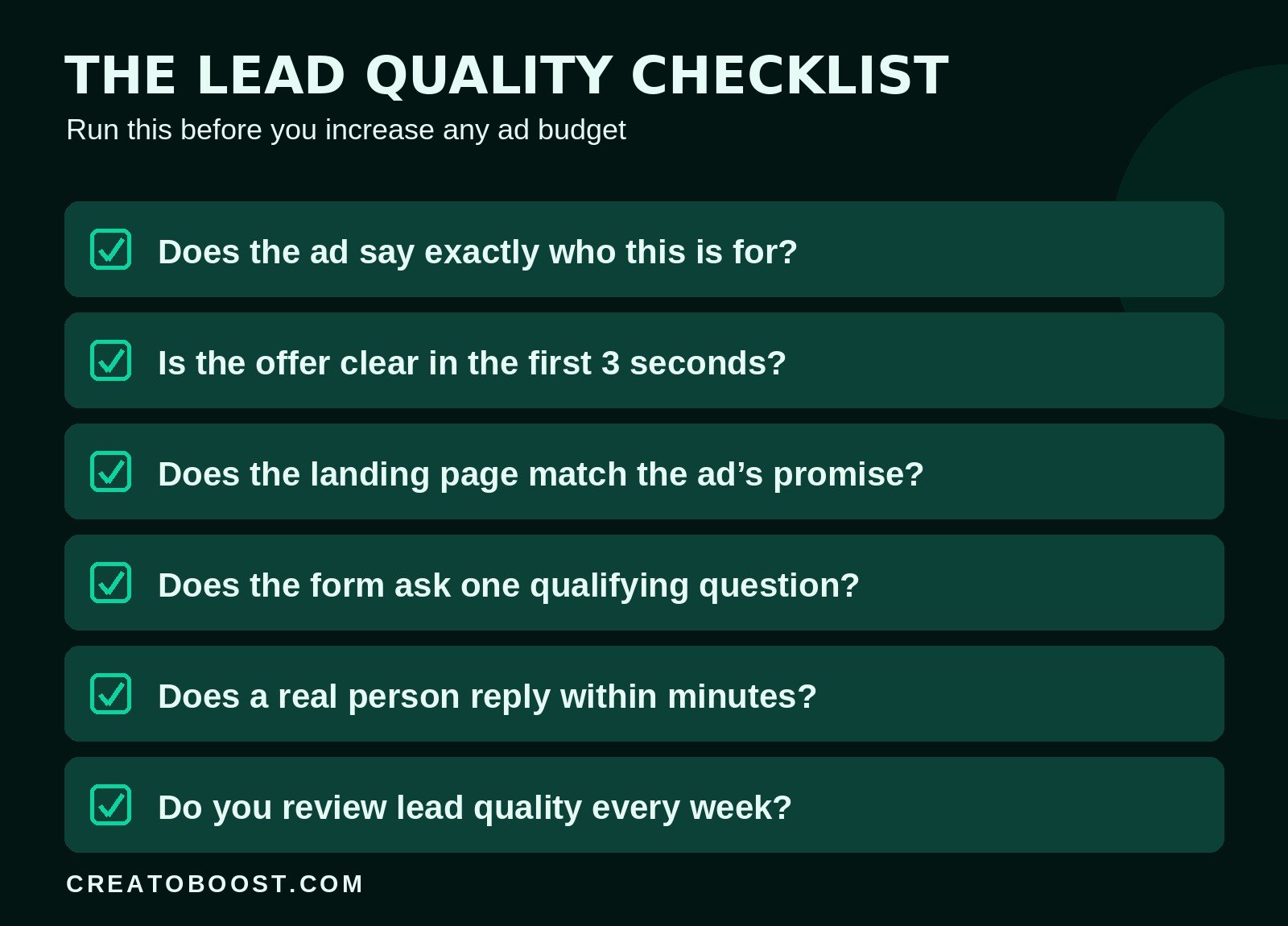
If you answered “no” anywhere, that is your bottleneck. Fix that step before spending more.
Common Mistakes We See
- Judging ads by cost per lead only. A slightly more expensive lead that converts is cheaper than a “cheap” lead that never buys.
- One ad, one audience, no testing. Campaigns improve by testing creative and offers, not by hoping.
- Sending clicks to the homepage. The page must continue the ad’s conversation.
- No follow-up system. Leads are perishable. Every hour of delay costs money.
- Changing everything at once. Change one thing, measure, then decide — otherwise you never learn what worked.
Frequently Asked Questions
How much budget do I need to start Meta Ads for lead generation?
There is no single right number — it depends on your market, your offer and your cost per enquiry. What matters more than the starting budget is having the funnel above in place, so the budget you do spend can actually convert. We plan budgets with clients after a free audit, based on their goals.
Are Facebook Lead Ads or website forms better?
Both can work. Instant forms inside Facebook usually bring more leads with less effort from the user; website forms usually bring fewer but more serious enquiries. Many businesses test both and keep the one that produces more qualified enquiries.
Why do I get messages but no sales?
Usually one of three reasons: the ad attracts the wrong people, the offer is unclear so people enquire “just to ask the price”, or follow-up is slow. The checklist above helps you find which one.
How long before Meta Ads bring results?
Enquiries can start as soon as a campaign is live, but judging a campaign fairly takes a short testing period — enough data to see which creative and audience actually produce qualified leads. Anyone who guarantees you specific results is not being honest with you.
Can AI help with lead generation ads?
Yes — mainly with creative. AI makes it practical to produce and test many video ad variations quickly, which is exactly what lead campaigns need. The strategy, offer and follow-up still need human judgement.
The Bottom Line
Meta Ads do not create demand out of thin air. They put your offer in front of the right people — and then your funnel decides what happens next.
Audience, creative, offer, page, follow-up. Get those five right, review quality every week, and clicks start turning into customers.
If you would like a second pair of eyes on your funnel, start with a free Growth Opportunity Audit from CreatoBoost. We will review your current ads and show you exactly where the leaks are — then you decide what to do next.
Claim your free audit · Or see how our lead generation service works.